
TL;DR
Modern distribution networks rely on real-time visibility to avoid costly delays, prevent failed deliveries and keep customers informed. This guide explains how visibility works across carriers, warehouses and fleets, the technologies that power it, and why it is essential for sectors where timing, compliance and accuracy matter. You will also learn how visibility reduces risk, improves customer experience and strengthens delivery performance from warehouse to endpoint.
Understanding Supply Chain Visibility
Supply chain visibility is the ability to track and monitor products, materials and information as they move from suppliers through manufacturing, warehousing and delivery to the final customer. It is similar to having a GPS for every item in your operation, except it shows much more than location. It reveals what is happening to each product, when it will arrive and any issues that might develop along the way.
According to Capgemini, last-mile inefficiencies can significantly increase operational costs, while 60% of consumers say delivery experience directly affects loyalty. Most courier companies, healthcare distributors and motor parts networks operate with significant blind spots, discovering problems only after customers call to complain.
Supply Chain Visibility Definition
Supply chain visibility refers to the ability to track and monitor products, materials and information as they move through suppliers, warehouses and distribution networks. Modern visibility platforms capture data at every touchpoint.
- For healthcare distributors handling cold chain products, this means every transfer must be recorded.
- For motor parts distributors, timed deliveries to garages are essential to avoid workshop downtime and missed service slots.
Metafour-enabled operators collectively manage more than 95 million annual shipments, which means even small blind spots can lead to temperature excursions, missed PODs, or failed deliveries that cost between 10 and 20% of total logistics spend in some sectors.
How Supply Chain Visibility Works Across Logistics Networks
Visibility relies on interconnected systems that continuously collect and share data. The goal is to combine information from carriers, warehouses, suppliers and internal systems into a single, reliable view.
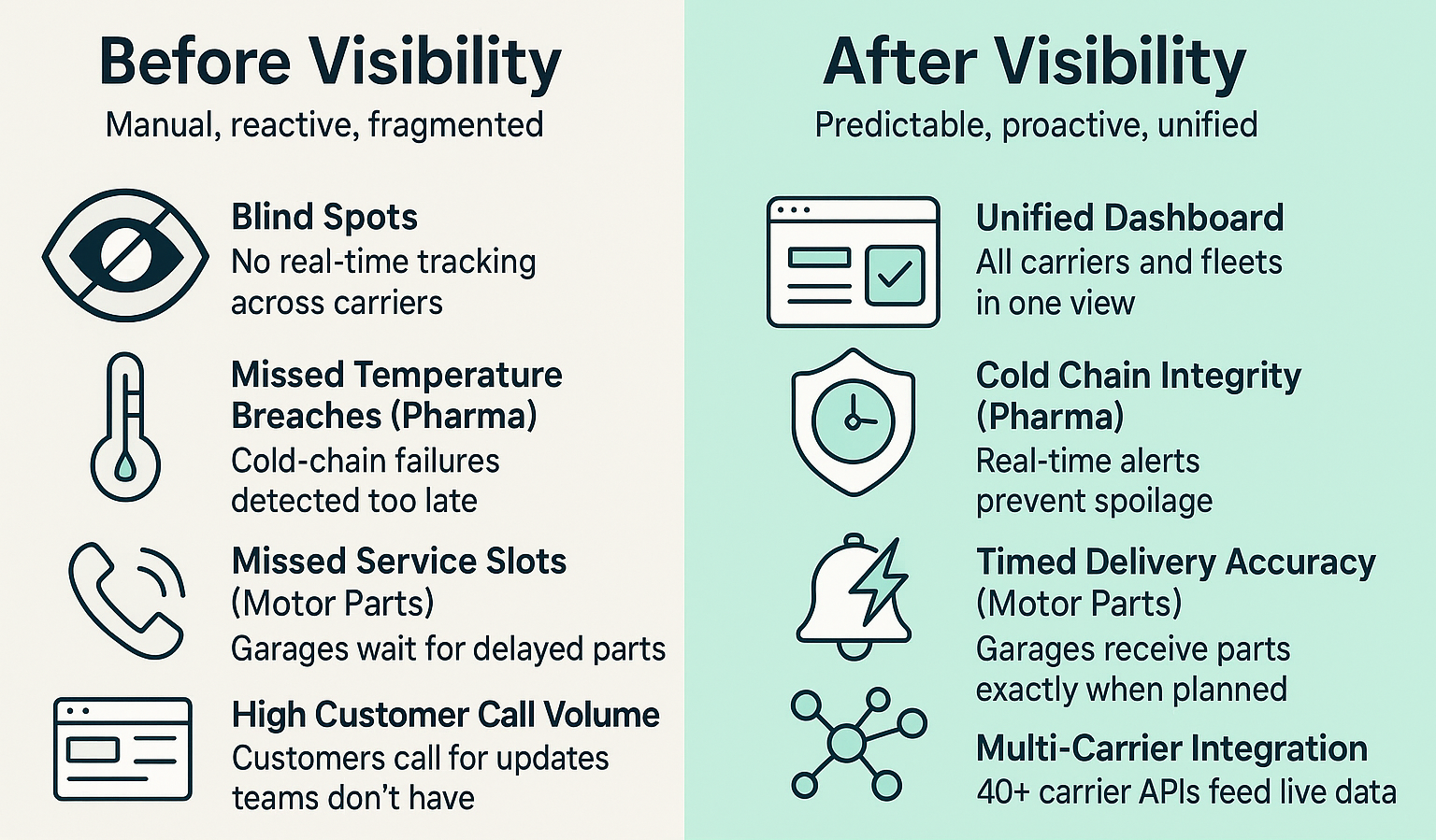
This matters because visibility gaps lead to:
- Pharmaceutical non-compliance when temperature drops go undetected
- Workshop downtime if motor parts miss service slots
- Incorrect handling of warranty or defective stock
- High inbound call volume from customers seeking updates
- Confusion in hybrid fleets where own vans and carriers operate separately
Carrier API Feeds
Carrier API feeds provide real-time updates every time a parcel is scanned, moved or delivered. This is vital for hybrid fleets using both in-house drivers and external carriers. A missing scan can trigger a compliance issue in healthcare logistics or cause a missed garage slot in automotive work.
Metafour integrates with more than 40 carriers, solving the common problem of manually juggling multiple tracking portals.
IoT and Sensor Data
IoT devices track temperature, humidity and impact conditions throughout transit. This is essential for regulated and sensitive goods such as pharmaceuticals and fragile automotive components.
IoT enables:
- Cold chain integrity from warehouse to endpoint
- Early detection of temperature breaches
- Protection of fragile or high-value parts
- Monitoring of handling conditions for regulatory compliance
LF&E relies on this kind of monitoring for specialist healthcare deliveries to maintain strict quality standards in healthcare distribution.
Cloud Dashboards and Alerts
Cloud dashboards consolidate all activities across carriers and fleets into a single view. Automated alerts notify teams of exceptions, helping to prevent compliance breaches, missed deliveries and poor customer experience.
This improves:
- Temperature monitoring for healthcare deliveries
- Timing accuracy for garage deliveries in automotive networks
- Customer service efficiency
- Multi-carrier and multi-fleet coordination
In the LF&E rollout, dashboards and automated workflow management significantly improved nationwide performance.
The Business Impact of Supply Chain Visibility
Without visibility, operations become reactive and costly. Failed deliveries can account for 10 to 20% of logistics costs. For motor parts distributors, delays can stall workshop operations. For healthcare distributors, temperature excursions can lead to non-compliance and wasted stock.
Visibility strengthens four business areas:
Cost reduction
- Fewer redeliveries
- Less wastage from temperature breaches
- Lower labour costs from manual checks
- Reduced downtime for garages waiting for crucial parts
Customer experience
- Garages receive accurate ETAs for high-volume parts flows
- Pharmacies and clinics receive more predictable deliveries
- Patients experience fewer delays
- Customer queries drop significantly
Risk management
- Detection of cold chain deviations
- Clear audit trails for regulators
- Lower risk of misrouted or mislabelled batches
- More controlled returns and recalls
Operational efficiency
- Hybrid fleets become easier to coordinate
- Warehouse teams prepare for inbound and outbound movements
- 3PL handovers become more predictable
- Stakeholders receive more reliable updates
Visibility is what you know internally. Transparency is what you choose to share externally. The strongest operations blend both to maintain confidence and trust.
Real-Time Supply Chain Data Visibility Technologies
Modern visibility depends on the right combination of technologies. These tools capture, transmit and interpret data so teams can respond quickly and prevent failures.
RFID and Barcode Scanning
- Supports high-throughput DC environments
- Reduces misrouted parts in automotive networks
- Ensures batch accuracy for pharmaceuticals
GPS and Telematics
- Critical for timed motor part deliveries to garages
- Helps maintain accurate ETAs for healthcare routes
- Improves journey performance insights
Predictive Analytics
- Forecasts delays on known high-risk cold chain lanes
- Predicts peak workshop demand periods
- Identifies routes with historically poor performance
Together, these technologies create the foundation for reliable, real-time visibility across regulated and time-sensitive supply chains. When combined within a single platform, they give teams the insight needed to maintain compliance, protect service levels and keep deliveries on track.
How To Improve Supply Chain Visibility: 5 Steps
Improving visibility does not require a full overhaul. Most organisations build it gradually, starting with the biggest blind spots.
-
- Map Data Sources and Gaps: Identify shortcomings such as missing temperature logs, incomplete carrier updates or lack of own-fleet visibility.
- Integrate Carrier and Warehouse Systems: Fix hybrid fleet fragmentation and remove multi-portal tracking.
- Standardise Data Formats and KPIs: Align temperature logs, timestamps and parts codes.
- Automate Alerts and Exception Workflows: This is essential for temperature breaches, missed PODs, late depot departures and missed service-centre slots.
- Measure ROI and Iterate: Visibility reduces failed delivery cost, customer service workload, compliance risk and stock write-offs.
Delivery transparency is becoming a basic requirement rather than a differentiator, and businesses that fail to modernise will fall behind operators with stable, data-driven performance.
Metafour Delivers End-to-End Visibility Into Supply Chain Logistics
Metafour’s cloud-based delivery platform provides visibility across booking, dispatch, tracking, reporting, invoicing and carrier management. With forty-plus carrier integrations, real-time dashboards and robust security certifications, it helps operators eliminate blind spots and maintain reliable delivery performance.
Choosing the right visibility platform is essential for maintaining reliable delivery performance across complex networks. The best systems integrate seamlessly with your existing tools, support hybrid fleets and provide the level of control required in high-precision industries.
- Security and Compliance Standards: Metafour is certified to ISO27001 and Cyber Essentials, essential for healthcare and regulated distributors.
- Integration Flexibility: Your platform should connect to your WMS, ERP, CRM and all carriers. Metafour integrates with more than 40 carriers.
- Scalability and Support: Choose a system that scales with volume and offers knowledgeable support specific to logistics and courier operations.
If you want to reduce failures, improve SLA performance and deliver with confidence, request a demo today and start your transformation.